


.png)
Helping Nashville Couples Figure Out Their Wedding Timeline

Updated: Feb 5
A Helpful Guide to Planning Your Ceremony and Reception Timeline
If there's one thing that makes couples nervous when planning their wedding, it's figuring out the timeline. Couples not only in Nashville, Tennessee, but across the country have the same questions:
When should the ceremony start? How long is cocktail hour supposed to be? Is dinner 30 minutes or an hour? When does our first dance take place? When should the celebration end?
If you're asking these questions, you're not alone. Most Nashville couples don't know how their wedding day timeline should flow, and that's completely normal.
This guide is here to help you understand your wedding timeline from ceremony to reception, how long each part should be, and how working with talented DJs like Nashville-based DJ Hank Austin and your venue helps everything run smoothly.
When Should Your Ceremony Start?
One of the biggest questions couples have: when should the ceremony start?
The answer depends on when you want your celebration to end and how many guests you're having. Most couples want to start their ceremony between 3:00 PM and 4:00 PM, sometimes even earlier.
Guest Count Determines Your Timeline
Your guest count is the biggest factor in determining how long your reception will run.
For a wedding with 250 guests:
• Dinner service could take 1.5 to 2 hours, especially for plated dinners • The venue staff needs more time to serve everyone • Buffet service might save 30-45 minutes compared to plated service • Toasts and formalities also take longer with a larger crowd
For a wedding with 50 guests:
• You can have a great 4 to 5 hour wedding • Dinner service is much faster • The entire timeline moves more efficiently
How Much Dancing Time Do You Want?
For most weddings, 2 hours of dancing is pretty good. If your family and friends are wild and love to party, maybe 3 or even 4 hours of dancing time. It all depends on how your crowd celebrates.
A Realistic Timeline Example
Let's say you start your ceremony at 4:00 PM and your venue has a hard stop at 11:00 PM. Here's how the night actually plays out:
• 4:00 PM - 4:30 PM: Pre-ceremony seating music (30 minutes) • 4:30 PM - 5:00 PM: Ceremony (30 minutes) • 5:00 PM - 6:00 PM: Cocktail hour (60 minutes) • 6:00 PM - 7:00 PM: Dinner service (1 hour) • 7:00 PM - 8:00 PM: Toasts and formalities (1 hour) • 8:00 PM - 11:00 PM: Dancing (3 hours)
That gives you a solid 3 hours of dancing. If you want even more dancing time, you might want to work it out with your venue to go past the 11:00 PM time you originally set. Some venues will let you extend past your original stop time. This is something you want to coordinate with your venue beforehand to make sure that's possible.
Couples across the country struggle with wedding timelines for exactly this reason. If you're having your wedding in Nashville, work with your venue, wedding planner (if you have one), and DJ to figure out the best ceremony start time based on your guest count, desired end time, and how much dancing time you want.
Understanding Your Ceremony Timeline
Most wedding ceremonies follow a standard structure, but timing depends on where you're getting married and what type of ceremony you're having.
Ceremony Length: Location Matters
Most wedding ceremonies outside the church run between 20 and 40 minutes. The exact length depends on what you include:
• Readings, poems, or special tributes from family members • Unity ceremonies like lighting a unity candle together • Sand pouring ceremonies (where the couple pours different colored sand into one bottle to symbolize two lives becoming one) • Cultural traditions • Length of vows (traditional vs. personalized)
Church Ceremonies Run Longer
If you are having your ceremony at a church, this will affect your start time for cocktail hour and your reception.
Church ceremonies can run anywhere from 45 minutes to an hour and a half, depending on the denomination and requirements. This is something you'll want to work out with your priest, pastor, or officiant to understand exactly how long your church ceremony will be.
Church Ceremony Start Times Are Usually Set
Most churches want to start the ceremony at 12:00 noon or usually 1:00 PM. Unless you have an incredible relationship with that pastor or priest, you're most likely not going to be able to start your ceremony at 3:00 or 4:00 PM.
This means if your church ceremony starts at 1:00 PM and runs until 2:30 PM, your cocktail hour and reception will start much earlier in the day than you might have planned.
Later Receptions Are More Fun
Something couples should remember: the later the reception, the more fun it is. If you want your wedding reception to be super fun, you want to push it back as far as you can.
Evening receptions have better energy. People are more relaxed, more ready to celebrate, and more willing to stay on the dance floor. If your church ceremony forces an early start, that's something to be aware of when planning your timeline.
The longer church ceremony directly impacts when your cocktail hour can start and when your reception will begin. Make sure your venue, DJ, and wedding planner (if you have one) know you're having a church ceremony so they can plan accordingly.
Don't Forget About Pre-Ceremony Seating Music
Before your ceremony officially begins, guests need time to arrive and be seated. Most professional DJs will play 20 to 30 minutes of seating music while family and friends gather and wait for the processional to begin.
Your ceremony timeline includes:
• 20-30 minutes of seating music (background music as guests arrive) • Processional music (bridal party and couple entrance) • Ceremony readings, vows, and rituals • Recessional music (newlyweds exit)
Working with a DJ who cares like Hank Austin in means your ceremony music hits every cue perfectly. No awkward pauses. No feedback. No delays.
Cocktail Hour: The Transition Between Ceremony and Reception
One of the most common questions couples ask: How long should cocktail hour be?
Cocktail Hour Is Usually 30 to 90 Minutes
The name is 'cocktail hour,' but the reality is it can be 30 minutes, 60 minutes, or even 90 minutes depending on your needs. It's still called cocktail hour regardless of length.
The exact length depends on:
• How long your wedding party and family photos will take • Whether you want to get all pictures done during cocktail hour • Venue setup and room turnover timing (especially if ceremony and reception are in the same room) • When the venue's kitchen can have food ready based on your specifications • Whether ceremony and reception are in different locations
Some couples choose 90-minute cocktail hours specifically to get all their photos done during that time. Others need it because the venue requires extra setup time or the food won't be ready yet.
What Cocktail Hour Is Really Designed For
Cocktail hour serves several important purposes:
• Gives the couple time to complete their wedding party and family photos • Allows family and friends to get acquainted or reacquainted • Lets guests unwind, grab cocktails, and drop off gifts at the gift table • Builds anticipation for the grand entrance that officially kicks off the reception
A seasoned DJ can help you figure out whether a 30, 60, or 90-minute cocktail hour makes the most sense for your specific wedding day timeline.
Who Decides How Long Cocktail Hour Should Be?
This is a collaborative decision between you, your venue, your wedding planner (if you have one), your photographer, and your DJ.
Your venue knows:
• Room turnover timing (especially if ceremony and reception are in the same space vs. different locations) • Kitchen timing and when food will be ready • Staffing flow and bar capacity
Your wedding planner (if you have one) will:
• Manage the photographer's time with you • Coordinate vendor timing • Make sure photos don't run too long
If you don't have a wedding planner, most capable DJs will coordinate directly with your venue's kitchen and manager to make sure the photographer isn't taking too long and that everything lines up correctly.
Your DJ focuses on guest energy and how cocktail hour timing affects the reception flow and dancing later in the night.
When your venue, planner, photographer, and DJ are all aligned and communicating, cocktail hour works exactly the way it should.
The Grand Entrance Officially Kicks Off Your Reception
After cocktail hour, the grand entrance is what officially starts your wedding reception. This is the moment guests have been waiting for.
What Is the Grand Entrance?
Your grand entrance is the introduction of your bridal party, the Who's Who of everyone involved in your wedding. This is when guests find out:
• Who are the parents of the couple? • Who are all the bridesmaids? • Who are all the groomsmen? • Who are the closest people to the couple in the wedding party?
The parents of the couple are usually acknowledged either from their seated tables or they come in with the bridal party. This is an exciting and proud moment for them. Everyone is excited and wants to show them love and energy when they are introduced into the reception venue.
Finally, the couple is introduced. This is the big "ta-da" moment, the moment everyone has been waiting for. The energy in the room peaks as the newlyweds make their entrance.
What Happens After the Grand Entrance?
Your grand entrance can lead into one of several things depending on your preferences:
• First dance (couple's first dance immediately after being announced) • Cake cutting (some couples cut the cake right after the grand entrance) • Group photo opportunity (couple and wedding party lined up for guests to take photos) • Direct transition to dinner seating
There's no single right order. Some couples want to do their first dance immediately, which is preferred because all eyes are on the couple as they share that powerful moment with everyone. Others are shy and prefer to do it after dinner.
DJ Hank Austin prefers to do the first dance before dinner. When the first dance happens right after the grand entrance, no one is eating, no one is mingling. All attention is on the couple. After dinner, everyone is eating and mingling, grabbing cupcakes and cake. That one special moment, the first dance, is the most important moment of the evening for the couple, and it deserves everyone's full attention.
When Does the First Dance Happen?
This varies by couple. Common options include:
• Right after the grand entrance (before dinner) • After dinner and toasts (leading into open dancing) • Partway through the reception as a special moment
DJ Hank Austin can help you decide what flow makes the most sense based on your vision for the night. There's no wrong answer, just different styles and energy levels.
Dinner and Toasts: Structure Keeps the Night Moving
Another common question Nashville couples ask: How long is dinner supposed to be?
Most Wedding Receptions Plan 45 Minutes to 1 Hour for Dinner
The exact time depends on your service style. Plated dinners tend to run closer to an hour. Buffet or family-style service can be 45 to 50 minutes.
During dinner, a well-planned timeline includes:
• Soft background music that enhances the room without overpowering conversation • Toasts spaced naturally so guests stay engaged • Clear sound so every speaker can be heard
When dinner flows smoothly, guests stay energized instead of restless. That energy carries directly into open dancing later.
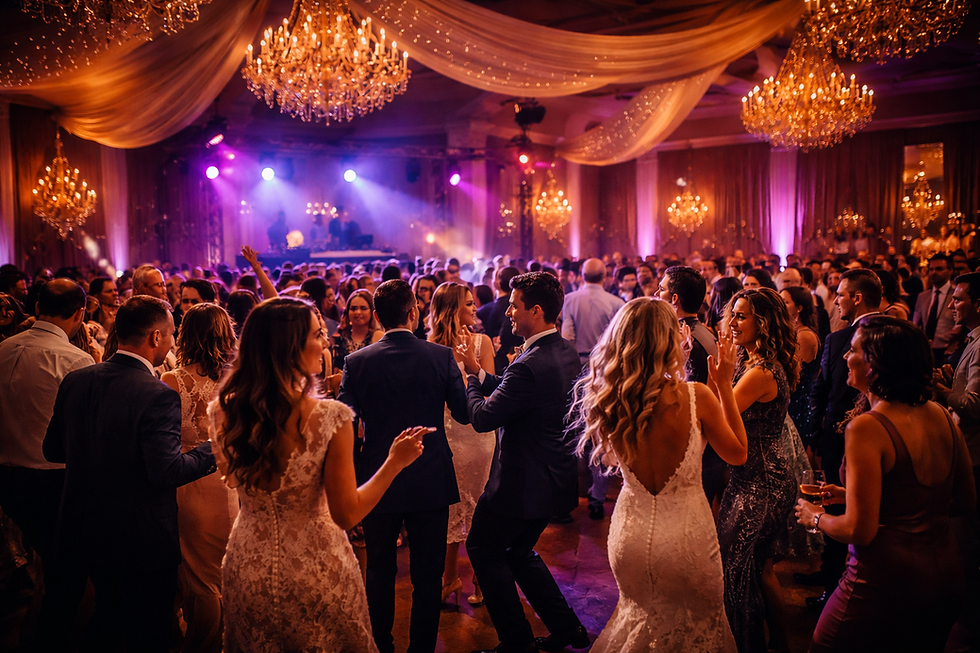
Open Dancing: Where Your Timeline Pays Off
This is the moment couples care about most, even if they don't say it out loud.
A Packed Dance Floor Depends on Everything Before It
When earlier parts of the reception are rushed or drag on too long, guests feel it. When the timeline is balanced, dancing feels natural and effortless.
Most Nashville couples want to know:
• How do you keep the dance floor full all night? • How do you balance different age groups? • How do you handle requests without killing the vibe?
DJs with 10+ years of experience understand timing, genre rotation, and crowd psychology. They don't just play popular songs. They play the right music at the right moment.
This is where 10+ years of DJing weddings shows.
When Should Your Wedding Reception End?
Most Nashville wedding receptions run 4 to 5 hours total from the start of cocktail hour to the end of dancing.
A typical timeline looks like this:
• Cocktail hour: 30–60 minutes • Grand entrance and first dances: 15–20 minutes • Dinner and toasts: 45–60 minutes • Open dancing: 2–3 hours • Last dance and exit: 5–10 minutes
Many venues have hard stop times (10:00 PM, 11:00 PM, or midnight). Your wedding DJ in Nashville will help you work backward from that end time to make sure everything fits without feeling rushed.
Flexibility Matters More Than Perfection
No wedding runs exactly on schedule.
Speeches run long. Family members disappear for photos. Bar lines get backed up. The cake cutting takes longer than expected.
A professional DJ and venue team know how to:
• Adjust the timeline quietly • Keep guests unaware of changes • Protect your experience as a couple
Your timeline is a guide, not a rigid script. The goal is a night that feels smooth, fun, and stress-free.
What Nashville Couples Should Look for When Planning Their Timeline
If you're planning a wedding in Nashville, Tennessee, you're not expected to have your ceremony and reception timeline figured out on your own.
What matters is working with professionals who:
• Help explain the timeline clearly and simply • Offer structure without pressure • Adjust when the night doesn't go exactly as planned • Have experience managing hundreds of weddings
Look for a wedding DJ in Nashville who:
• Asks about your vision before suggesting a timeline • Works collaboratively with your venue and planner • Explains what works and why • Reads the room and adjusts in real time
A great wedding timeline supports the night without ever stealing attention from it.
The Real Goal: Your Wedding Should Feel Effortless
When your wedding ceremony and reception timeline is done right, guests don't notice the structure. They just feel the flow.
Your reception doesn't feel scheduled. It feels natural. It feels fun. It feels like you.
That's what couples planning weddings in Nashville should look for.
If you have questions about your wedding timeline, you're not alone. Reach out to DJ Hank Austin who can walk you through it step by step.
Your timeline matters. Get it right, and everything else falls into place.
Comments